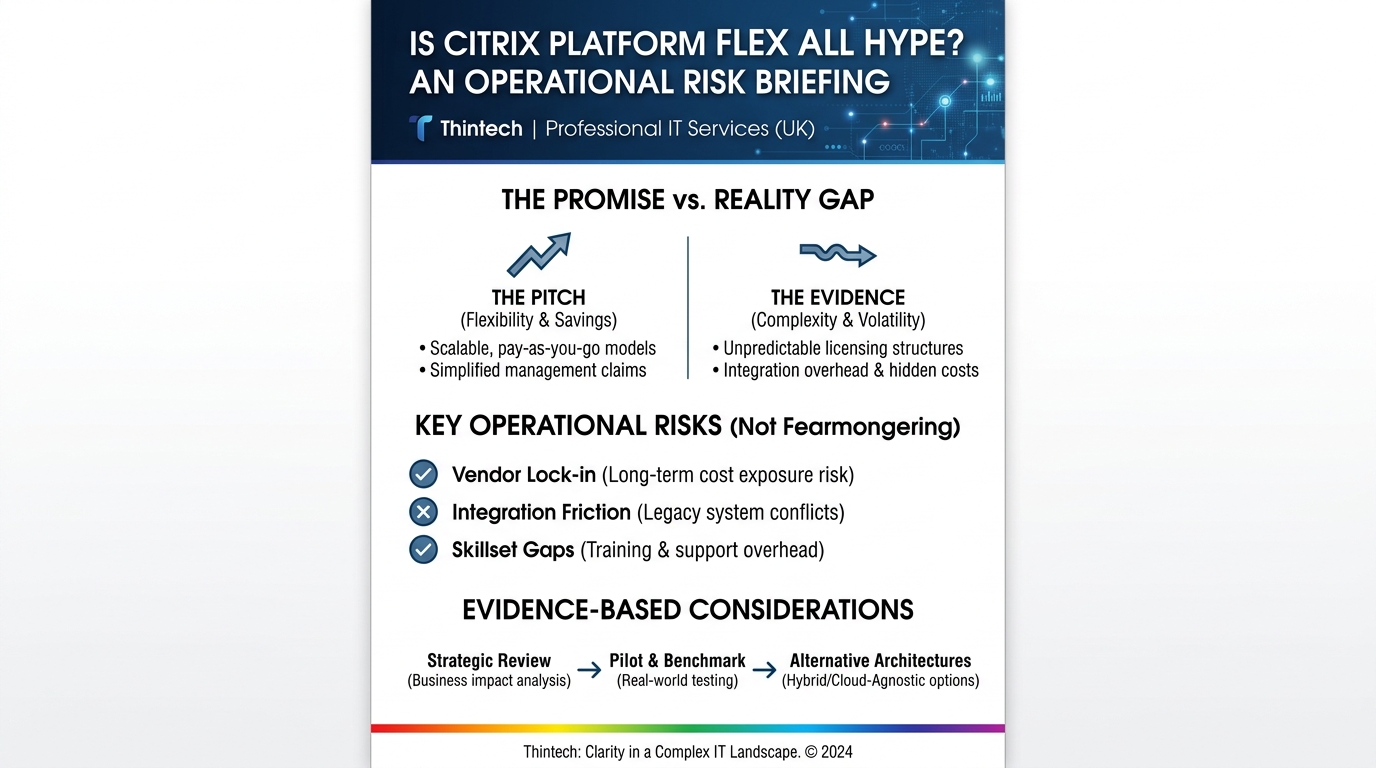
Is Citrix Platform Flex all hype?
Citrix Platform Flex is not all hype. But it is also not something EUC leaders should accept as a complete answer just because the packaging sounds modern.
The interesting part of Platform Flex is the shift in framing. Citrix is no longer talking only about virtual desktops as the default answer to every access problem. It is presenting a persona-based secure access platform: managed desktops for users who need them, browser-based access where that is enough, and zero trust access patterns for applications that should not require a full desktop at all.
That is a sensible direction because most organisations already know the old model is too blunt. Some users need a persistent, controlled desktop. Some need secure browser access to SaaS. Some need private app access from unmanaged or lightly managed devices. Some need high-performance sessions for specific workloads. Treating all of those personas as one desktop problem creates cost, support drag and architectural compromise.
So the useful question is not whether Platform Flex is a clever launch name. The useful question is whether it helps a Citrix estate become more honest about who needs what. If it drives better segmentation, cleaner access patterns, right-sized desktop capacity and clearer ownership of user experience, then it can be valuable. If it simply repackages existing licences without changing the operating model, it will feel like more vendor theatre.
The cost story needs particular care. Persona-based delivery can reduce waste, but only if the organisation has the discipline to map real user groups, measure consumption and retire unnecessary desktop use. Without that work, Platform Flex could just move spend into a different commercial shape while leaving the same support tickets, the same login friction and the same unclear ownership between security, EUC and infrastructure teams.
There is also a governance angle. Browser isolation, zero trust access and managed desktops are not interchangeable controls. They solve different risk problems. A finance user handling regulated data, a contractor on an unmanaged device and a task worker accessing one internal app should not automatically receive the same architecture. Platform Flex is most credible when it is used to make those design choices explicit.
Thintech's view is that Platform Flex deserves a proper assessment, not a reflexive dismissal. The right response is to run a short evidence exercise: identify three to five core workforce personas, map their current access pattern, calculate support and infrastructure cost, then test whether the Platform Flex model genuinely simplifies delivery. That turns the conversation from Citrix marketing into an operational decision.
The verdict is therefore measured. Platform Flex is a useful signal of where secure access is going: less one-size-fits-all desktop delivery, more persona-based access design. The risk is assuming the product creates that discipline by itself. It does not. The value appears only when the estate is mapped, the cost model is visible, and each persona gets the least complex access pattern that still meets the business and security requirement.